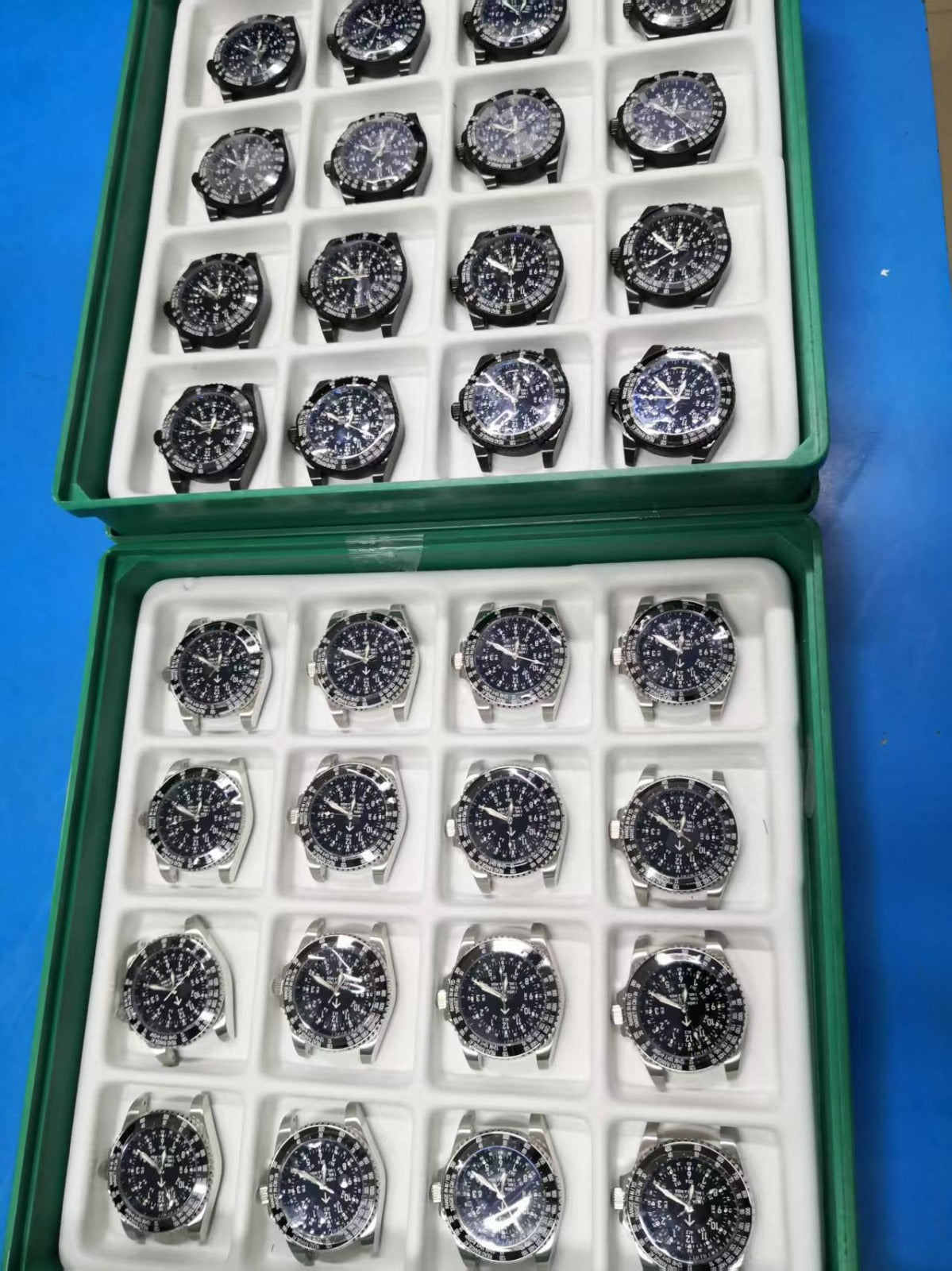
NOTE: THIS IS A PRE-ORDER FOR A NEW VERSION OF A WATCH THAT WILL BE SHIPPED IN AUGUST.
The Kickstarter for the new shooting watch ends in:


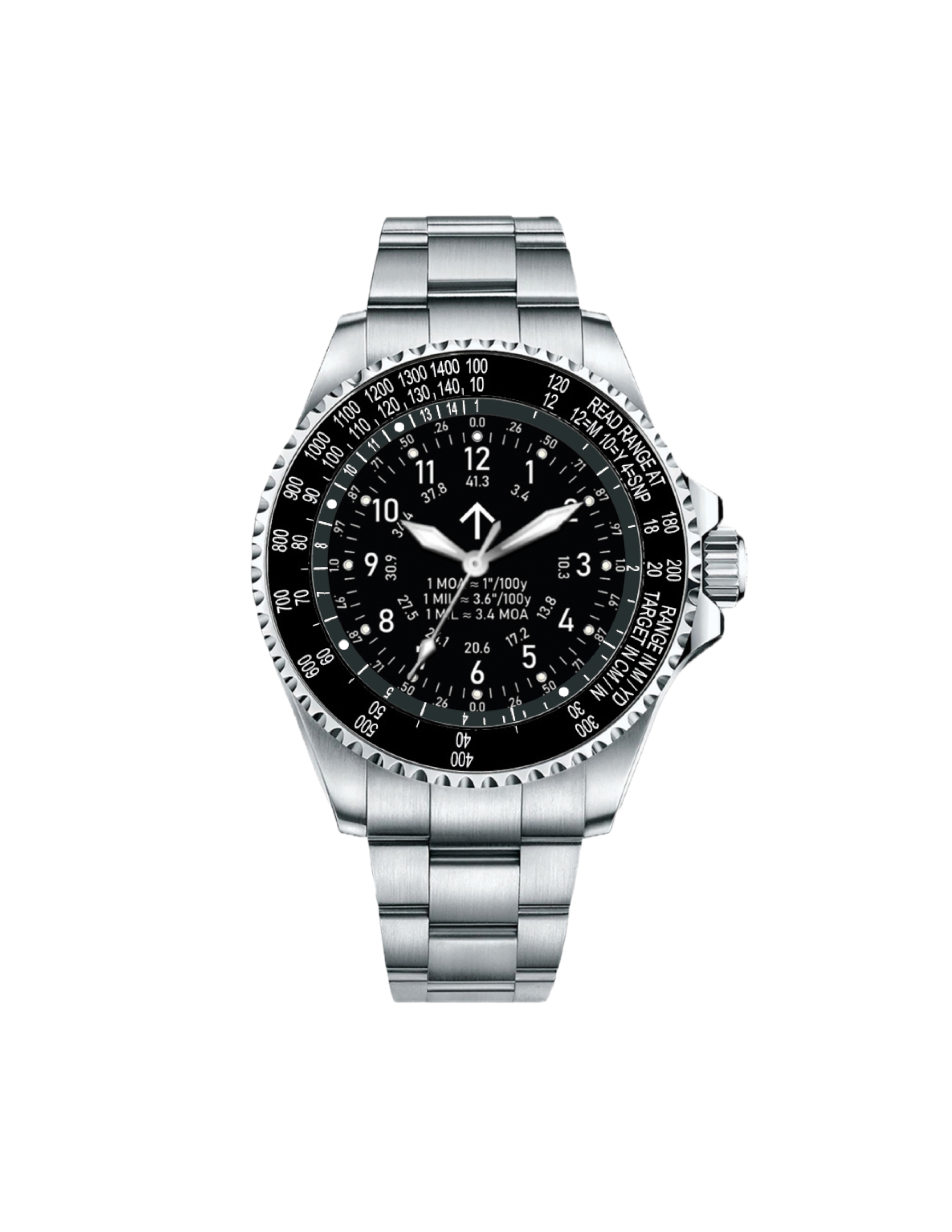
This Seiko powered automatic 200m tool watch was designed for long-distance shooters. It does three jobs, besides tell you the time:

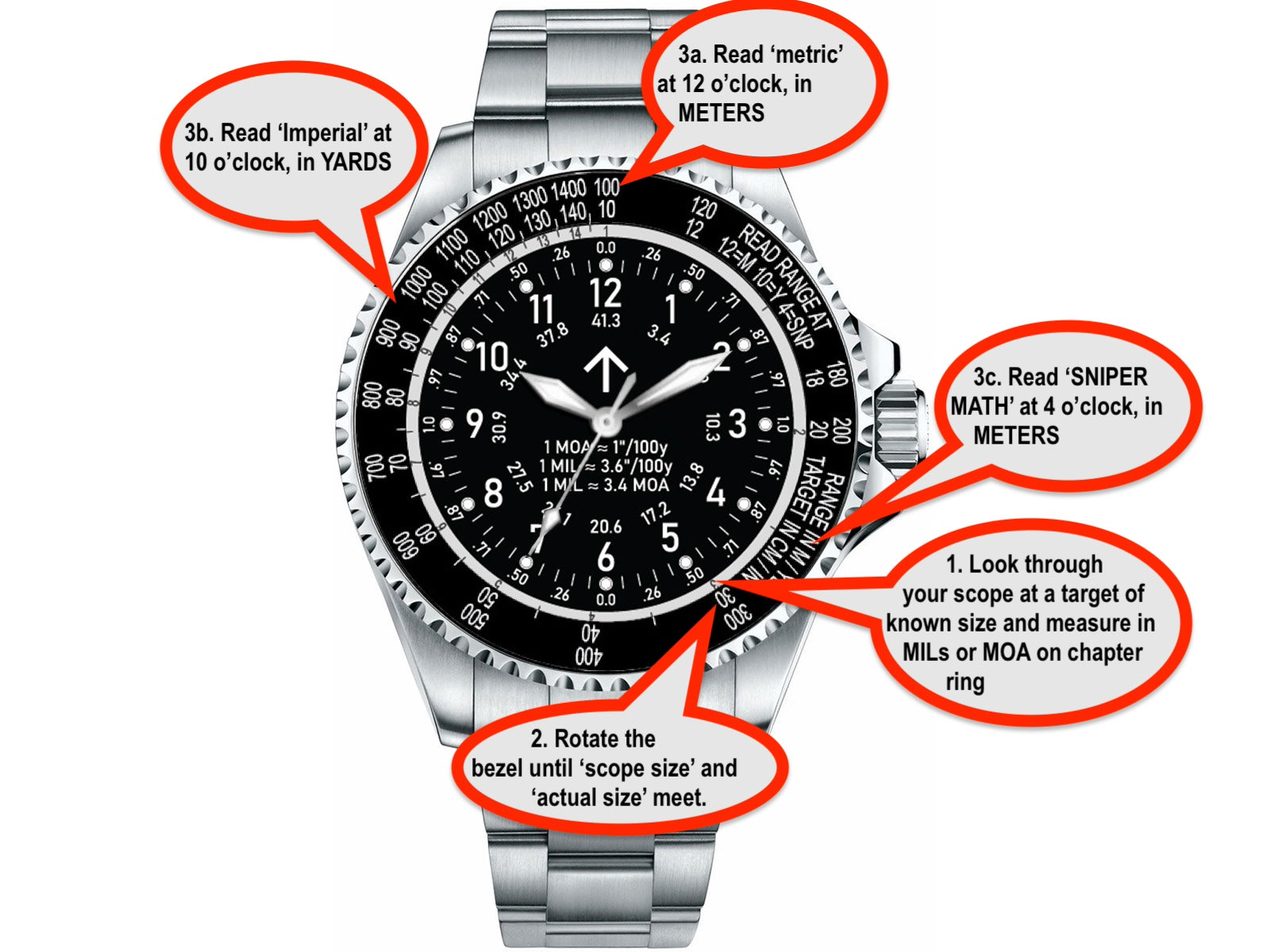
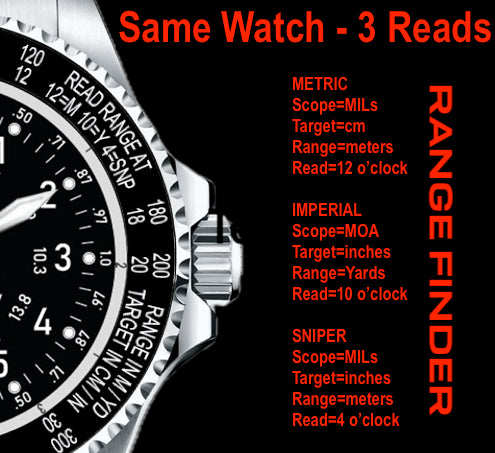
You can use it to range in METRIC (cm/m/MIL), by reading the range at 12'oclock, or IMPERIAL (inches/yards/MOA) if you read range at 10 o'clock. And if you are a SNIPER (inches/m/MIL) you can read your range at 4 o'clock.
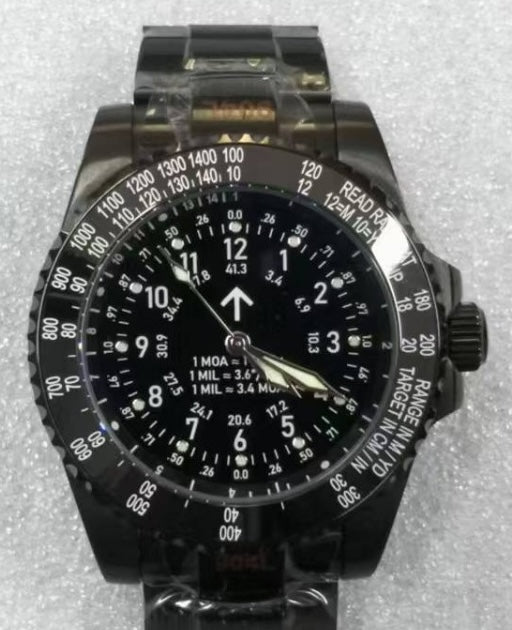
Since this watch doent exist yet, let me show you the FIRST version, that was crowdfunded at Indiegogo LAST YEAR, because the only thing that will be different is the bezel insert and the addition of a chapter ring...
__________________
This watch is for shooters who run mil reticles and need quick checks without pulling out a device, or a piece of paper and pen. It's built for the line, the field, and anywhere electronics are slow, not allowed (F Class PRS), or just not wanted (Snipers can now be detected wearing ‘smart watches’). If you work with a spotter or shoot in mixed-standards teams, the MIL-to-MOA reference keeps you moving.
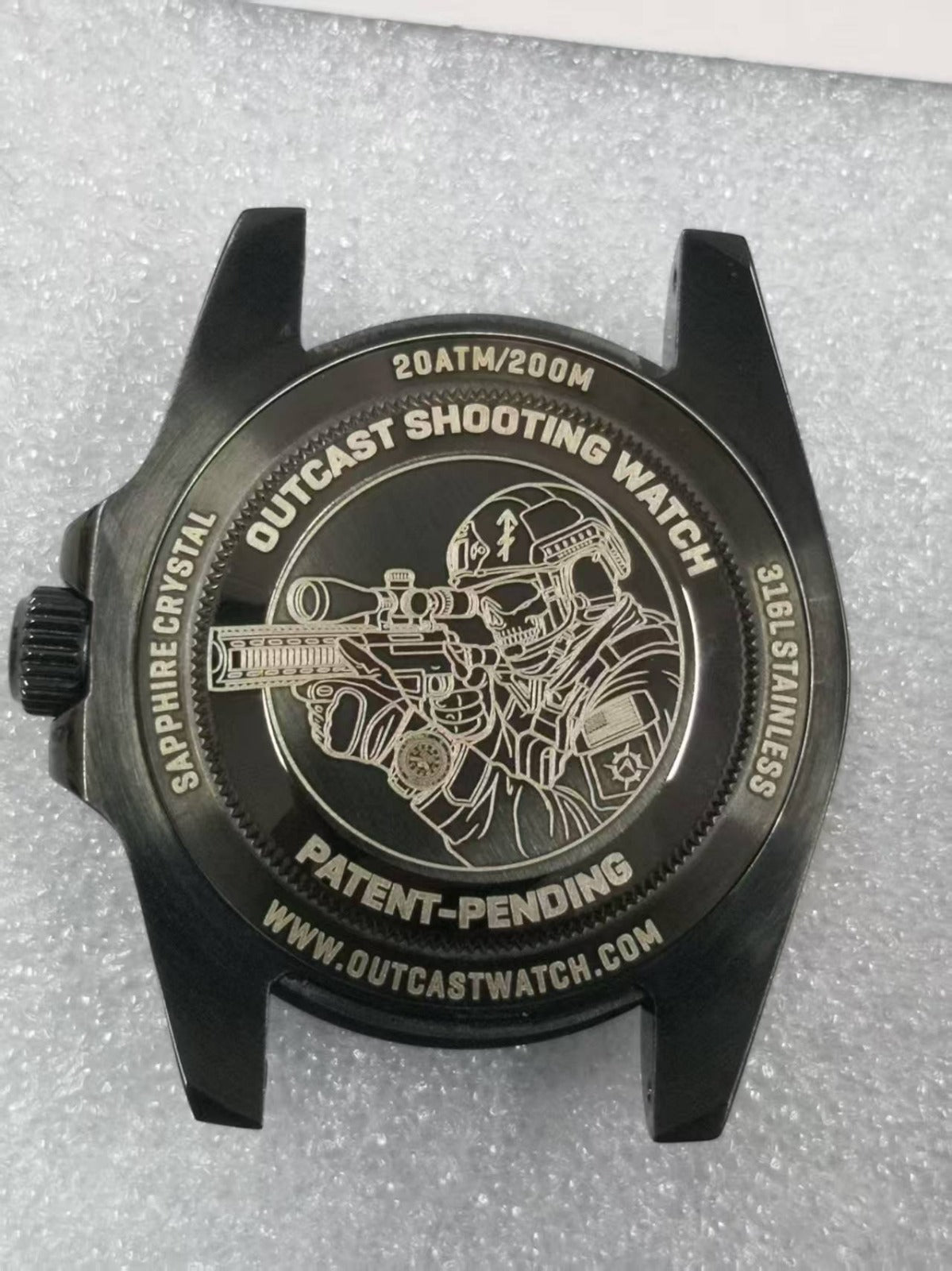
The case was been upgraded this year and is being tested by over 60 Army Snipers who (acting as individuals) used my online builder to customize a watch to their needs and tastes. Then we did a special batch that was engraved with the Army’s Sniper Association Logo, with that association’s written permission. Many of the Snipers also not only gave input on the model they received, but helped sanity check edge case scenarios of the version we are crowdfunding today, to make sure the math not only was correct, but also made sense for their needs, not just the needs of hunters and precision rifle shooters.

__________________

The original version of this watch used this same exact dial, with crosswind multipliers and a MIL-to-MOA scale. The NEW version we are crowdfunding today, adds a tool bezel with a logarithmic rangefinder system, using the rotating bezel and the inner rehaut/chapter ring, and a new 200m case.
__________________
The Rangefinder
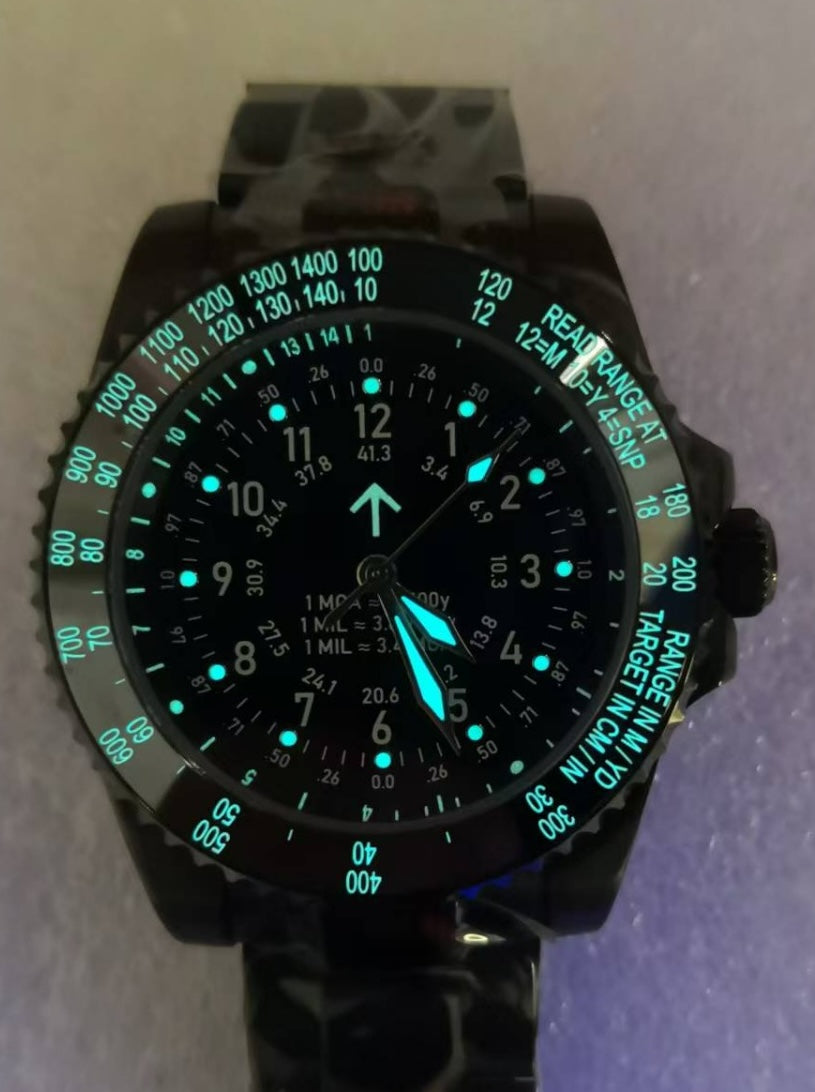
The rangefinder uses two parts with measurement markings: the bezel, which is the rotating outer ring, and the chapter ring, which is the fixed inner ring under the crystal. The rehaut is marked with a mil scale from 1 to 15. The bezel has two matched logarithmic scales: one for target size (10 to 150) and one for distance (100 to 1500). If you know any two of the three variables—target size, observed mils/MOA, or distance—you can solve for the third.
The scale is calibrated to the standard METRIC mil relation (centimeters to meters). Imperial readings (inches to yards) are also supported, as is the strange 'mixed math' that snipers use.
Metric example: You're looking at a target you know is 30 centimeters tall. In your reticle, it measures 3 mils. You rotate the bezel so the "30" mark lines up with the "3" mark on the rehaut. Then you look at the 12 o'clock position on the bezel. It reads 300 meters. That's your range distance.
Imperial example: You're looking at a target you know is 12 inches tall. In your reticle, it measures 2 MOA. You rotate the bezel so the "12" mark lines up with the "2" mark on the rehaut. Then you look at the 10 o'clock position on the bezel. It reads in YARDS. That's your range distance.
Sniper example: You want your scope in MILs, but you want your target sized in INCHES... but then you want your range in METERS. You guys read your range at 4 o'clock.
The SAME watch can be used for all three..... you're welcome:)
__________________
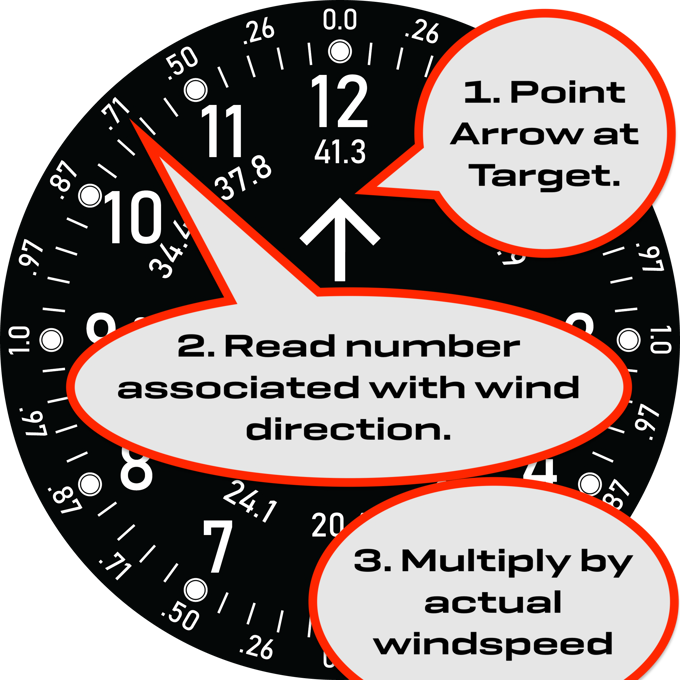
Wind from an angle is not full-value wind. You need the crosswind component before you apply your dope. Point the ARROW on the dial to the TARGET. The dial edge shows your crosswind adjustment multipliers based on wind coming from that direction. You take your measured wind speed and multiply it by the factor shown for that angle. At 30 degrees (1 o'clock or 11 o'clock), the multiplier is 0.50. At 45 degrees (1:30 or 10:30), it's 0.71. At 60 degrees (2 o'clock or 10 o'clock), it's 0.87. At 90 degrees (3 o'clock or 9 o'clock), it's 1.00, which is full value.
Here's an example. The wind is 10 miles per hour from about 2 o'clock. You look at the dial and see the multiplier is 0.87. You multiply 10 by 0.87 and get 8.7 miles per hour. That's the effective crosswind you use in your hold at the actual distance.
__________________
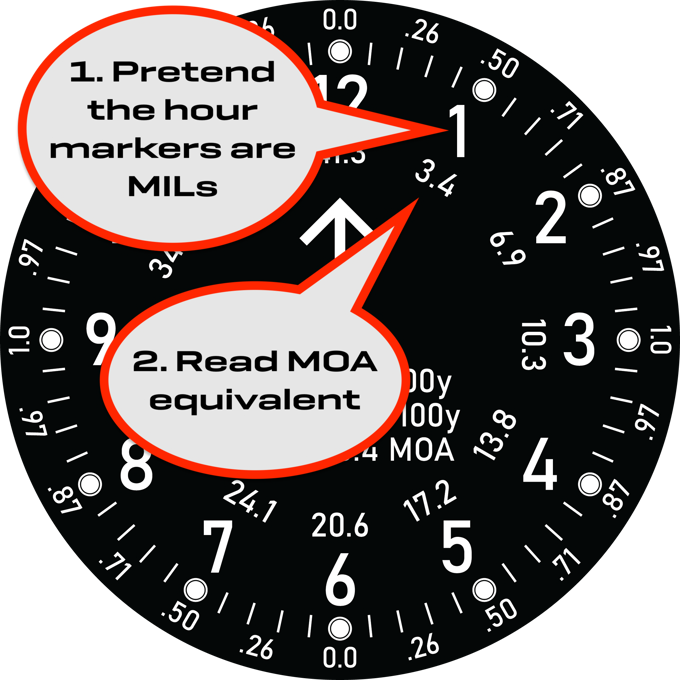
The inner track on the dial shows common MIL increments and their MOA equivalents. The rule is simple: MOA equals mil times 3.438. The watch gives you quick anchors. Half a mil is about 1.72 MOA. One mil is about 3.44 MOA. One point two mils is about 4.13 MOA, which is roughly 16 clicks on a quarter-MOA turret. Two mils is about 6.88 MOA. If your spotter calls 1.2 mil up and your scope adjusts in MOA, you glance at the watch, see 4.1 MOA, and dial 16 clicks. Done.
__________________
This new watch costs more than my other ones; it has a new, additional chapter ring, and I also had to modify the internal structure of this case to accommodate it. And the new case has to be produced for us and stocked by us. That's a change from the previous runs. Up to now we were able to use off the shelve parts, but no longer. Minimum order quantities now apply to the case, as well as everything else - in 100-unit increments - so that requires large lump-sum payments up front.
Crowdfunding covers the minimum order quantity so we can build enough inventory to avoid selling out immediately, which is what happened last time. (Every time we got the design in from of the right target audience, we sold out.) And we anticipate even stronger sales this time and we want to meet demand without delays and interruptions. It takes 3 months to get parts; so it’s easy to get behind the ball right when we are trying to scale.
__________________
You get:
__________________
Sometimes it's better to just shut up, sit down, and let others speak on your behalf...


__________________
I offer discounts to Military/First Responders/Teachers through GOVX, and if you are LEO Contact me to get a coupon.
Choose options

